You Do Not Fear Death, You Fear an Unlived Life
For most of my life, I thought I was afraid of dying.
The thought would come at night, the way it comes to everyone. The lights off, the house quiet, and suddenly the simple, enormous fact that one day I will not exist. My heart would speed up. I would push the thought away and reach for sleep, for my phone, for anything that could fill the silence before the silence got too loud.
I called it a fear of death.
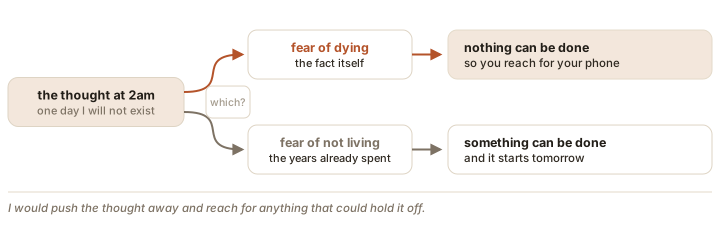
I was wrong about what I was afraid of.
It took me years, and one particular stretch of difficulty I will not detail here, to understand that the fear had never really been about the ending. The ending is abstract. You cannot picture your own absence. What was actually frightening me, what was making my chest tighten in the dark, was something far more specific and far more within my reach.
I was not afraid of death.
I was afraid that I would die without ever having lived.
Those are not the same fear. I had spent years confusing them, and the confusion was costing me everything. Because a fear of death is useless. There is nothing to do with it. You cannot prepare, you cannot prevent, you can only worry. But a fear of an unlived life is the most useful feeling a person can have, because it points directly at something you can still change, today, while there is still time.
The day I separated the two, something in me shifted that has never shifted back.
I started to notice how much of my life I was postponing. The conversations I kept meaning to have. The work I told myself I would begin once conditions were perfect. The person I kept promising to become, always next month, always after this one last thing. I had been treating my life like a rehearsal, as if the real performance were scheduled for some later date that would announce itself when I was finally ready.
But no one announces it.
There is no later date. There was only ever this, the ordinary unglamorous now, and I had been spending it waiting for a beginning that was already happening without me.
What truly frightened me, once I looked at it honestly, was the image of myself at the end, looking back, and seeing a long corridor of almosts. The risks I did not take because I was waiting to feel certain. The things I did not say because I was waiting for the perfect moment. The love I held back to protect myself from a rejection that, from the vantage point of the end, would have meant nothing at all. I was not scared of running out of time. I was scared of reaching the end and realizing I had never actually used the time I had.
That realization changed how I see almost everything.
It changed how I see fear itself. I used to think fear was a wall, a sign to stop. Now I have learned that most of my fears were quietly trying to keep me small and safe in a room where nothing could hurt me and nothing could happen either. The same walls that keep out the danger keep out the life. I stopped asking what is the safe thing and started asking the only question that the end will care about. Will I regret not having done this?
It changed how I see time. I no longer experience days as something I am owed an endless supply of. I feel the edges of them now. Not in a morbid way, but in a way that makes the ordinary almost unbearably vivid. A normal afternoon. A meal with people I love. The fact that any of this is happening at all is, when I actually stop to feel it, astonishing. The awareness of the ending is what taught me to taste the middle.
It changed how I see other people. I stopped waiting to forgive. I stopped rationing my affection as if there would always be a better, more convenient time to give it. When you truly understand that everyone you love is also moving toward the same horizon, the pettiness falls away. The grudges look absurd. The unsaid things start to feel like crimes against the little time we actually have together.
And it changed how I see myself, which is the part that matters most.
I no longer measure my life by how safe it is. I measure it by how fully I am using it. The fear has not vanished. It still visits me at night sometimes. But now, when it comes, I do not run from it. I let it ask its question. And the question is no longer am I going to die. Of course I am. The question is the better one, the useful one, the one that actually changes how I live the next morning.
Am I living, or am I only postponing?
That is the fear worth listening to. Not the ending. The waste.
Because the truth I have built my life around now is simple, and it has never once let me down.
I am not afraid of death the way I thought I was.
I am afraid of arriving there having never truly arrived anywhere else.
You do not fear death.
You fear an unlived life.
And the only cure I have ever found is to stop saving my life for later, and to finally, fully, begin it now.