Your Parents Are Not Comparing You, They Are Measuring Themselves
There is a boy who has lived in your house your whole life and has never once visited.
He scored ninety four. You are not certain which year, or in which subject, or whether it was ninety four at all, because the number has been repeated so often that it stopped being a number some time ago and became a kind of weather. He got in on the first attempt. He is settled now, and settled is the highest word available in the language your family uses about the future.
Nobody has actually seen him in about nine years.
The standard explanation for all this is that they think it motivates you. That they mean well, that every child is different, that it is love arriving badly. Most of that is probably true. It also explains nothing, because it treats the whole business as a technique that misfired, a good intention that got lost somewhere between the heart and the mouth. That is not what happened. The technique is working. It is simply not doing the job you assumed it had been hired for.
Think about what your father had to work with.
He was raising a child in a country where the number of good outcomes was small, the number of seats smaller, and the distance between the people who got through and the people who did not tended to be permanent. There was no aptitude assessment. No counsellor with a chart. Nobody ever sat him down and said, here is what your son will probably be good at, plan accordingly. He had two instruments. Your rank in a class of sixty, and the children of people he knew.
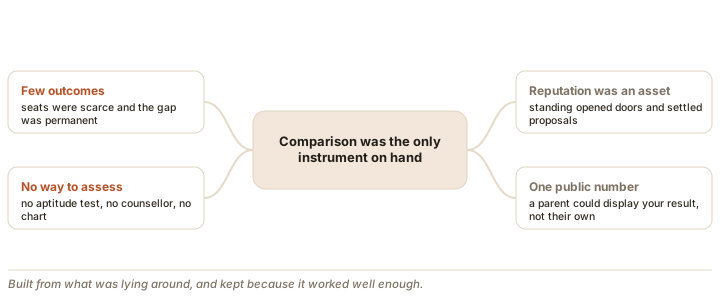
The second one was the better instrument, and that is the part that gets skipped when people call it lazy. A rank tells you where a child stands in one room in one year. The neighbour’s son tells you where a whole life goes. You can watch him from eleven to thirty two. You get to find out whether the boy who topped in school actually ended up anywhere. He was longitudinal data, running in real time, and he cost nothing to collect.
So the instrument got built out of what was lying around, and it worked well enough that everybody kept it.
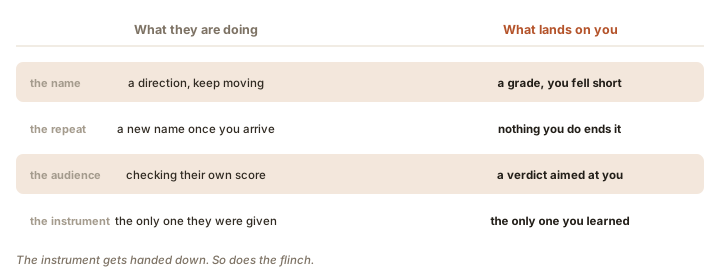
The trouble with any instrument is that it is indifferent to whatever it touches. A thermometer in a wound reads temperature. It has nothing to say about pain, and it is not being cruel about it, it was simply never built for that. When your father says the name at dinner he is taking a reading. What arrives at your end of the table is a verdict. Two different events, and most of the damage lives in the gap between them.
You beat him sometimes. It happens. You clear the thing he cleared, you end up earning roughly what he earns, you arrive at the exact spot his name was being used to point at.
Give it a season.
There will be a new name by then. A cousin who went to Canada. Someone’s daughter. A boy from the next lane who started something small that is apparently doing very well.
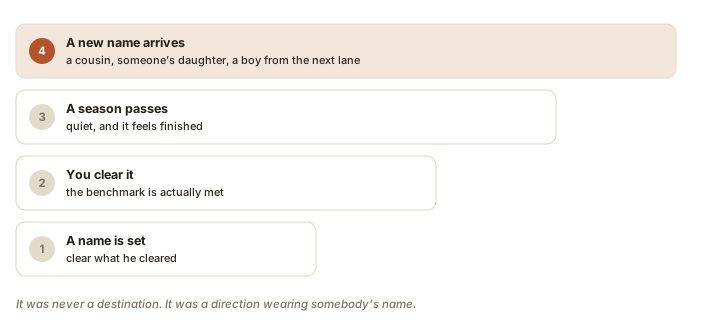
If the point had been for you to arrive, arriving would have finished it.
There is also the question of who was listening, which I think matters more than it first appears. Watch when the comparisons actually happen. They cluster. At weddings, at funerals, in the twenty minutes after relatives arrive and before the food comes out. Somebody asks what you are doing these days, and the answer that gets given is not really an answer about you.
In a community where reputation was a working asset, where a family’s standing was the thing that got a door opened or a proposal taken seriously, a parent had almost nothing they were allowed to display. They could not hang their own competence on a wall. They could hang yours. Your outcome was the one public number they owned, and when it gets read out in a room full of people whose opinion once determined real things, some part of what is happening is a man checking his own score.
None of which makes it land any softer. A score read out in your direction hits you whether or not you were the intended reader.
And you do the same thing.
Not with a neighbour’s son. With parents. Somewhere in your head there is a family who let their son take a year off and never once asked about it, who said do what makes you happy and appeared to mean it, who paid for the whole thing and never mentioned it again. You have used them. Not out loud, probably. But in the argument you run at two in the morning, where you are the prosecution and they are the evidence.
Same instrument. Same absent person doing all the work. Same refusal to look at whoever is actually in the room.
I do not know how to put that down without it reading as a rebuke, and I do not entirely mean it as one, because the two are not equivalent. They had authority over you and you had none over them, and that asymmetry is not a detail. But the mechanism is the same mechanism, and the person operating it at two in the morning is not being graded by anybody except himself.
The conversation where you explain all of this and they understand it does not happen. Not in the version you rehearse in the shower, where you are calm and they are quiet and somebody finally says the thing.
What is actually available is smaller and entirely internal. He says a name. You take the reading and you refuse the verdict, separately, in the second and a half before your face moves. A name is a direction. It is not a grade. Underneath it is a request, which is roughly keep going, and sitting on top of it is a sentence, which is roughly you are behind, and you are allowed to accept the first and decline the second without announcing to anybody that you have done it.
Then stop running your own version. Not because it is unfair to them, although it is. Because your parents are getting older at the ordinary rate of about a year a year, and every hour spent measuring them against a family you have never met is an hour given to people who do not exist, taken from two who do.
The boy is not coming. He was never coming. He does not know your name.
You will probably keep hearing his.