Boredom Is Not a Verdict on the Thing in Front of You
The hobby lasted eleven days.
You were genuinely excited about it. You watched the videos. You bought the thing, you cleared a shelf for it, and somewhere in the second week the excitement went flat in a way you could not argue with. The shelf became a shelf again. This has happened with enough hobbies, jobs, cities and people that you have started to suspect the pattern is not about any of them.
The suspicion is right. The conclusion people draw from it is not. They decide they are shallow. Or broken. Or that nothing is interesting anymore, which is the same verdict with better manners. There is a narrower conclusion, and it is the useful one. Boredom is not a report on the thing. It is a report on the connection between you and the thing, and that connection can fail in two completely different places.
Psychologists argued about which one was the real cause for a long time.
One camp said attention. John Eastwood and his colleagues defined boredom in 2012 as the aversive experience of wanting, but being unable, to engage in satisfying activity. A mind idling in gear. The other camp said meaning. You are not bored because you cannot focus. You are bored because the thing does not matter, and your attention is refusing to pretend otherwise.
In 2018 Erin Westgate and Timothy Wilson made the argument look like a false choice. Both camps were describing something real, and either fault is enough on its own.
The attention fault is a mismatch rather than a shortage. It fails when the thing asks more of you than you have left. It fails when it asks less. That is why one word has to cover a tax form and a queue. The meaning fault is separate and simpler. Your focus can be perfectly intact and the thing still not worth your morning. Two faults. One word for both.
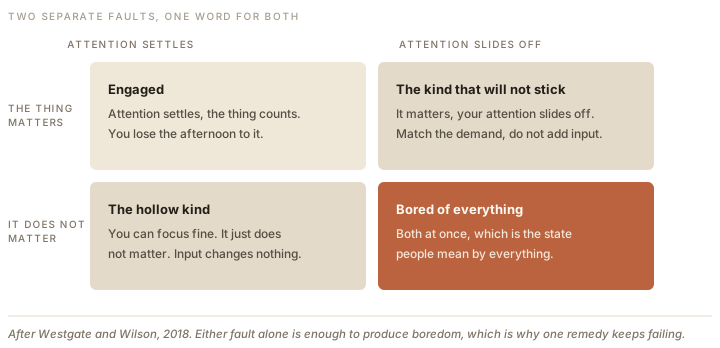
The remedy everyone reaches for aims at one of them, and aims badly.
Scroll. Switch tabs. Start a new project, book a trip, buy the thing for the shelf. All of that is more input, and more input lowers what is being asked of you rather than raising it. For a mind under-occupied by something it already cares about, that is the wrong direction. For the other fault it does nothing at all. It does nothing quietly, too, because the first few days of anything new feel like a cure. Eleven days later you are holding the same feeling and a shelf to clear.
So the question is not how to stop being bored. It is which of the two is missing.
There is an exercise for that. Put everything down. No phone, no music, no window. Sit for fifteen minutes with nothing but your own thoughts.
Timothy Wilson ran roughly this experiment in 2014 and published it in Science. Participants sat alone for up to fifteen minutes, told to entertain themselves by thinking. Each had been given a mild electric shock beforehand, and had rated it unpleasant enough to say they would pay money never to feel it again. During the thinking period they could press a button and shock themselves. Of the forty-two people who had said they would pay to avoid it, sixty-seven percent of the men pressed the button. So did a quarter of the women.
The study is more contested than the headline suggests. Kieran Fox and three colleagues published a commentary making the obvious objections. On average, participants rated the fifteen minutes as somewhat enjoyable. Some of them cheated and reached for their phones. And a button marked shock is the kind of button people press to see what happens, which is curiosity, not preference. Take it as a hint. Not a proof.
It is still worth having, because it lines up with something much older. I have written about Pascal’s observation that much of our unhappiness comes from the inability to sit quietly alone in a room, and I said then that his insight was not about boredom but about avoidance. I think that was half right. They are the same move seen from two sides.
The useful part of the fifteen minutes is not whether the silence fills. It is what it fills with.
If it fills with the life you already have, with the argument you need to finish and the thing you want to go and build, then attention was the bottleneck in that hour. That is the better of the two problems to have. It is still a problem, and the repair is matching what your days ask of you to what you have to give, in whichever direction is off.
If it fills with somewhere else entirely, another city, another job, a different set of people, your attention is working fine. You have been spending it on things you do not actually value, probably for sensible reasons, probably for a long time. No new hobby is going to touch that.
And if it does not fill at all, stop here. Flatness that has covered everything, including the two or three things you know for certain you love, arriving alongside changes in your sleep or your appetite, is not a subject this essay is qualified to discuss. That one belongs with a doctor, not a shelf.
Two things worth separating out, because they look like this and are not.
The first is the fade after you get what you wanted, where the promotion stops feeling like anything and the car you dreamt of just feels like a car. That is not boredom. That is the baseline resetting, and it happens whether or not the thing mattered.
The second is the sense that the years are speeding up. That has its own mechanism, and it is about memory rather than engagement. A repetitive year is not a boring one. It just leaves less behind to count.
What is left, once you take those away, is a question with an answer. Not an interesting answer. Not a fast one. Boredom that has spread to everything is the earliest free signal most people get that the days are not the ones they would have chosen. It is not a clean signal. By the time it covers everything, both faults are usually running at once. But it arrives before the regret does, and that is the whole of its value.
You will clear the shelf again for something else, probably soon. That part does not stop. But the shelf was never the thing you were deciding about.