The People Who Betray You Were Once the People You Defended
Let me tell you about someone I will call A.
A was not an acquaintance. A was the person I argued for in rooms they were not in. When others questioned A, I corrected them. When someone said be careful with that one, I felt offended on A’s behalf. I lent A my reputation like it was nothing, because that is what you do for people you have decided to trust.
I did not get betrayed by a stranger.
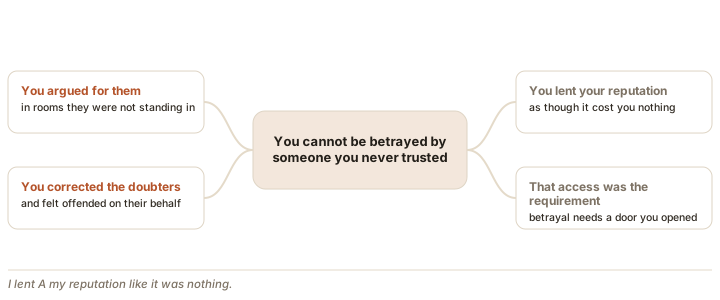
Strangers cannot betray you. They were never inside the gate.
I got betrayed by someone I had personally walked to the front of the line. Someone I vouched for. Someone whose name I had tied to my own, on purpose, with both hands.
That is the detail no one warns you about.
The people who betray you are almost never the ones you were watching.
They are the ones you stopped watching. Because watching felt like an insult to how much you trusted them.
I have thought about this for a long time, and I keep arriving at the same uncomfortable place. Betrayal requires access. And access is not something an enemy can take. It is something only you can give. Every real wound of this kind has your fingerprints on the door it walked through.
The cruelty is in the order of events.
First you defend them. You explain away the small things. The comment that felt off. The story that did not quite line up. The moment someone raised an eyebrow and you raised your voice to shut it down. You build a case for them in your own mind and you appoint yourself their lawyer for free.
Then they use the exact trust you manufactured.
Not a stranger’s trust. Yours. The specific, hard-won, fully-extended trust that only someone close could ever have reached.
I used to think betrayal was about the moment of the knife. It is not. The knife is the last page. The real story is everything before it. The years of being defended. The benefit of the doubt handed over again and again. The warnings from other people that you treated as jealousy or negativity, when sometimes they were just other people who had already been where you were standing.
There is a version of me that is angry about this.
But the anger keeps slipping, because it has nowhere honest to land. I cannot fully blame A without also looking at the person who gave A the keys. And that person was me. Trusting. Loyal. A little proud of how loyal I was.
I am not telling you to stop trusting people. That advice is for cowards, and it does not even work. A life with the gate permanently shut is not safe. It is just empty. You trade the pain of betrayal for the slow ache of never letting anyone close enough to matter, and that is a worse deal than it sounds.
What I am telling you is smaller and harder.
Notice who you are defending so loudly.
Notice when your loyalty has become a refusal to see. There is a difference between trusting someone and going deaf to everything about them. Real trust can hear a hard truth and stay. Blind loyalty cannot, because it has built its whole identity around the person being exactly who you decided they were.
The ones who hurt you the most will always come from inside that circle.
Not because the world is cruel.
Because that is the only place the damage can be done from.
A taught me something I did not want to learn. That the size of a betrayal is just a measurement of how much you gave. You cannot be deeply betrayed by someone you held at a distance. The depth of the wound is the receipt for the depth of the trust. In a strange way, getting hurt like that is proof that you were capable of loving someone without conditions.
I have decided not to let that capacity die.
I still vouch for people. I still hand over the keys, eventually, to the few who earn them. But I do it with my eyes open now. I let people show me who they are at full volume before I appoint myself their defender. I no longer mistake my own loyalty for evidence of their character.
If you have an A, you already understand all of this.
You know the worst betrayals do not come from the people you feared.
They come from the people you protected.
The people who betray you were once the people you defended.
And the lesson is not to stop defending people.
It is to make sure they are worth the version of you that did.