The One Who Forgives First Is Not the Weaker One, They Are the One Who Remembers More
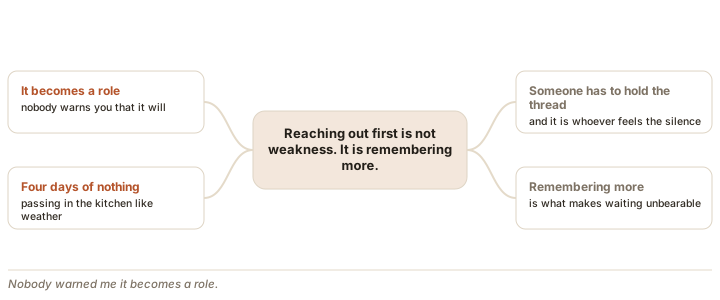
Nobody warned me it becomes a role.
The night I mean was in December. My father had said something about my job that landed wrong, and I said something back that landed worse, and for four days we did the thing our family does, which is nothing. We passed each other in the kitchen like weather systems. My mother kept looking at both of us the way she looks at a pot that might boil over.
On the fifth day I called him.
Not because I had cooled off. I hadn’t. My chest was still tight with what I thought I was owed, an apology, some acknowledgment that he was the one who started it. I called anyway. I said something small and easy to say, asked about his knee, let the real thing sit unspoken between us like a guest neither of us would name. He softened. We moved on. Nobody ever said sorry. I have never once, in thirty some years, heard my father say the word.
I told myself that call cost me nothing. That’s the first lie. It cost me the version of the story where I was right and got to stay right. I would rather be less right and less alone. It cost me the apology I never got and stopped expecting. Small currency. I paid it without counting, the way you pay for something you’ve paid for so many times the price stops registering.
I want to say I did it out of love, and some of it was love, real and stubborn. But I’ve learned to distrust my own quick answer, because the quick answer is usually the flattering one.
So I circle it.
Once: was it love. Once: was it fear. Once more: was it just what I know how to do because someone had to do it first in that house, and I was the oldest, and the oldest learns early that silence left alone does not heal, it calcifies.
I think it was fear, mostly. Not fear of my father. Fear of the specific silence that comes after a rupture, the one that has no announced end date, the one that could theoretically go on forever if neither person moves. I have watched that kind of silence happen to other people. An aunt and an uncle who stopped speaking over money and were still not speaking when one of them died. I did not want to find out if my family was capable of that. So I moved first, every time, to make sure we never had to find out.
That’s not the same as being generous. I want it to be. It would be a nicer essay if it were.
Here’s what I know for certain, the part I’m sure of even when I’m not sure of my own motives. I remember the fight later than the other person does. Not because I’m noble. Because someone has to hold the whole shape of what happened, the before and the during and the after, if the thread is going to survive, and I have apparently decided, somewhere too early for me to consent to it, that the someone is me.
That’s not strength. People call it strength because it’s easier to admire than to examine. It’s memory with nowhere else to go. It’s a kind of vigilance that looks, from the outside, like grace.
Maybe that’s close enough to grace to count. I go back and forth on this more than I let on.
What I don’t go back and forth on is what happens in the years after. The apology that never comes stops feeling like a debt and starts feeling like a fact about the other person, not a verdict on me. My father will likely never say sorry to me. I have made a kind of peace with that, though peace is generous, call it an arrangement, and I have stopped waiting for the accounting to balance before I’m willing to speak again.
I don’t know if that makes me the bigger person. I know it makes me the one who remembers.
The one who forgives first is not the weaker one, they are the one who remembers more.