The Need to Be Understood Is the Last Vanity to Die
We give up our vanities in a rough order, and the order tells the story of a life. Early on, we crave to be seen, and so we chase attention in its loudest forms, wanting to be noticed in a room, counted, remarked upon. In time, if we are lucky, that hunger quiets. We learn that attention is cheap and that being noticed is not the same as mattering. Then comes the longing to be admired, to be thought talented or successful or good, and this one lasts longer, because it wears the respectable clothes of ambition. Eventually that too loosens its grip, usually after we have been admired for something and discovered how little the admiration touched the part of us that was actually lonely. We shed the need for praise. We shed the need for status. We shed, one by one, the desires to be envied, to be right, to win. And underneath all of them, surviving every other surrender, waits the final and most stubborn vanity of all. The need to be understood.
It is the last to die because it does not feel like vanity. It feels like a basic human right. Of all the things we want from other people, this is the one that seems most reasonable, most innocent, most clearly deserved. I do not need you to admire me, we tell ourselves, having grown past that. I do not need to impress you. I only need you to understand me. To truly see what I meant. To grasp why I did what I did, why I am the way I am, what I was actually carrying when I made the choice that you are judging. Surely that is not pride. Surely that is just the wish to be known.
And yet I have come to believe it is the deepest pride of all, precisely because it hides so well.
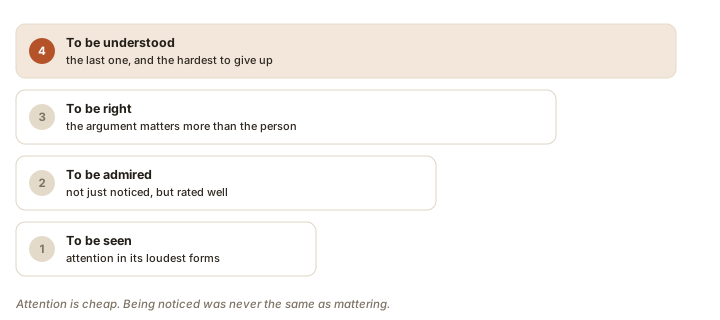
Consider what the need to be understood actually demands. It asks that another person reconstruct, inside their own mind, the full interior of yours. Your history, your fears, your private logic, the exact weight of the moment as you experienced it. It asks them to set down their own perspective entirely and inhabit yours without distortion. This is, when you look at it plainly, nearly impossible, and the insistence that it happen is a quiet refusal to accept the most fundamental fact of being a person, which is that no one will ever stand fully inside your experience. We are each sealed, finally, inside our own seeing. To demand to be understood completely is to demand that this seal be broken on your behalf, that the loneliness built into consciousness itself be suspended just for you.
I held this demand for most of my life without ever recognizing it as a demand.
I would replay conversations, agonizing not over being disliked but over being misread. Someone had taken my words and built from them a version of me that was not true, and it tormented me. I needed to correct it. I needed them to know what I had really meant. I would draft long explanations in my head, marshalling evidence, certain that if I could only present the full context, they would finally see me accurately and the discomfort would dissolve. The discomfort never dissolved. Because even when they listened, even when they nodded, I could never be sure the understanding had actually landed, and so the hunger simply moved to the next person, the next misreading, the next soul I needed to win over to the truth of me.
What I did not see was that the whole project was a performance of the ego in its most refined disguise. The cruder vanities want applause. This one wants something subtler and more total. It wants to control the image of you that lives in other minds. It cannot bear that somewhere out there, someone holds a version of you that is wrong, and it will spend enormous energy trying to reach into other people’s heads and correct the record. But other people’s understanding of you is not yours to govern. It never was. It is assembled out of their own histories and limits and wounds, and you have almost no authority over the result. The need to be understood is the need to rule a territory that does not belong to you.
The freedom, when it comes, comes from a strange and almost ungrateful place. It comes from accepting that you will be misunderstood, often, by people who are not even trying to misunderstand you, and that this is simply the texture of existence rather than a wound to be healed. The people who love you will get parts of you wrong. The people who dislike you will build a whole person out of those wrong parts and argue with that invention for years. And none of it, in the end, has the power over your peace that you once granted it. You can let them be wrong. You can let the false version of you exist in their minds, uncorrected, and discover that it weighs nothing, that it was only ever your own need that gave it weight.
This does not mean we stop wanting connection. The wish to be known by a few, deeply, is among the sweetest things a life contains, and I would not surrender it. But there is a difference between hoping to be understood and needing it. The hope is open-handed. It receives understanding as a gift when it arrives and does not collapse when it does not. The need is a clenched fist. It cannot rest until everyone has been corrected, and since everyone can never be corrected, it never rests at all. The need turns every relationship into a courtroom where you are forever the defendant, explaining, justifying, presenting the context, waiting for a verdict of comprehension that will somehow set you free. It never sets you free. It only ties you, more tightly each year, to the opinions of people who were never going to see you whole.
The day I began to loosen this was not a triumphant day. It was a tired one. I simply ran out of the energy to keep explaining myself, and in that exhaustion I stumbled into something that felt almost like grace. I let someone misunderstand me and did nothing. I did not correct it. I did not draft the speech. I sat with the discomfort of being wrongly seen, and I waited for the catastrophe, and the catastrophe did not come. The world held. I was still myself, exactly as much as I had been before, entirely independent of whether that person had grasped me correctly. The understanding I had been chasing for decades turned out to be something I did not actually require in order to be whole. I had only believed I did.
That is the secret the last vanity keeps from us. It convinces us that being understood is a need, a hunger we must satisfy to be at peace, when in truth it is the final luxury the ego refuses to release. To be at peace without being understood, to be content to be partly misread by nearly everyone and to know yourself anyway, is one of the quietest forms of freedom there is. It asks you to be the one who understands yourself, fully, and to let that be enough, so that the comprehension of others becomes a welcome addition rather than a desperate requirement.
We will keep wanting it, of course. The wish does not vanish. But we can stop being ruled by it. We can hold our own truth so steadily that we no longer need it ratified in the minds of others. And on the day you can be misunderstood by someone and feel your peace remain completely intact, you will know that the last and most stubborn vanity has finally begun to die, and that what is left standing in its place is something far better than being understood.
It is being free.
The need to be understood is the last vanity to die.
And the self that no longer needs it is the truest self you will ever meet.