Loneliness Is the Price of a Mind That Outgrew Its Room
There is a particular kind of loneliness that does not come from being alone.
It comes from growing.
You can be surrounded by people who love you, in the same house, the same conversations, the same town you have always known, and still feel a quiet distance opening up that no one else seems to notice. Nothing has gone wrong. No one has wronged you. You have simply begun to outgrow the room you were handed, and the room cannot grow with you.
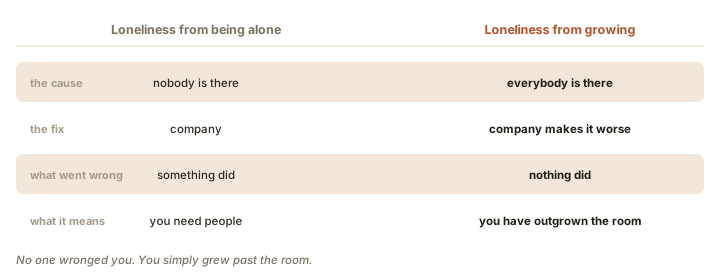
This is the loneliness no one prepares you for.
We are taught that loneliness is a deficit. A lack of company. A problem to be solved by adding people. But there is another loneliness that is not a lack at all. It is a sign of expansion. It is what the mind feels when it has moved past the borders of the world it was given and has not yet found the larger world it now belongs to.
The price of becoming more is, for a time, belonging less.
Schopenhauer, who understood solitude better than almost anyone, wrote that a man can be himself only so long as he is alone, and that he who does not love solitude will not love freedom. He saw what most people miss. The crowd asks you to shrink to the size of the average. To be perfectly at ease among others is often to have agreed, quietly, to think no thought they could not also think. The moment your inner world grows larger than the conversations available to you, ease becomes impossible. You feel the gap. And the gap aches.
I have felt this in rooms full of people I genuinely love.
Listening, nodding, present, and yet somewhere inside, a part of me standing slightly apart, aware that the thing I most wanted to say had no place to land. Not because anyone was beneath me. I want to be careful here, because this is where the feeling can rot into arrogance if you let it. It was not that they were smaller. It was that we had grown in different directions, and the shared ground we once stood on had quietly narrowed beneath our feet.
Nietzsche knew this terrain intimately, and he did not soften it.
He wrote that the higher we soar, the smaller we appear to those who cannot fly. There is cruelty in the line, but also accuracy. When you change, when you begin to want different things, ask different questions, refuse the comforts you used to accept, the people who knew the old you do not always see growth. Sometimes they see betrayal. Sometimes they see you leaving. And the loneliness doubles, because now you are not only alone in your thoughts, you are misunderstood in your becoming.
But Nietzsche also offered the other half, the half people forget.
He said that one must have chaos within oneself to give birth to a dancing star. The isolation is not the punishment. It is the womb. The distance you feel is the space in which something new in you is being formed, and that formation cannot happen in the noise of constant belonging. Every person who ever became more than they were had to pass through a season where they fit nowhere, precisely because they were no longer who they had been and not yet who they were becoming.
This is the part I have had to make peace with.
That the loneliness of growth is not a wrong turn. It is the toll booth on the road out of the small room. You cannot expand your mind and keep all the comforts of the size you used to be. Something has to be paid, and what you pay is the easy, automatic belonging you once took for granted. The unexamined company. The friendships built on shared smallness rather than shared depth.
There is an old line, often attributed to Aristotle, that the one who is unable to live in society, or who has no need because he is sufficient for himself, must be either a beast or a god. I think most of us, in these seasons, are neither. We are simply human beings caught in transit, having left one belonging and not yet arrived at the next.
Because here is the mercy hidden in all of this.
The loneliness of outgrowing a room is not the end of belonging. It is the painful gap between belongings. The room you outgrew was real, and it served you, and there is no shame in having loved it. But the mind that outgrew it is now searching, often without knowing it, for a larger room. New conversations. New people who are also too big for the spaces that raised them. They exist. They are usually quiet, off to the side, having learned the same hard lesson you are learning now.
You do not find them by shrinking back into the old room.
You find them by tolerating the loneliness long enough to keep growing, until your size calls to others of the same size. Kierkegaard believed that the crowd is untruth, and that the most decisive things happen to a person in solitude, in the long hours where no one is watching and there is no applause to perform for. It is in exactly those hours that you become someone worth meeting.
So if you feel it now, that ache in the middle of a full and good life, do not rush to diagnose yourself as broken.
Ask the harder question.
Have you stopped growing, and grown lonely from stagnation?
Or have you kept growing, and grown lonely because you are ahead of your own belonging?
The two feel almost identical from the inside, but they lead to opposite places. One asks you to return. The other asks you to continue, and to trust that a larger room is being built for you, one honest hour of solitude at a time.
Loneliness is the price of a mind that outgrew its room.
And no one who ever became truly themselves got to skip the bill.