Jealousy Is Just Admiration That Lost Its Courage
Every feeling we are ashamed of is a feeling we have refused to finish.
Jealousy is one of these. It is not a complete emotion. It is an interrupted one. Something began to move in us, reached toward the light, and then turned back before it could become what it was trying to become. What we call jealousy is the residue of that retreat. It is the shape an admiration leaves behind when it is abandoned halfway.
To understand it, you have to go back to the moment before it has a name.
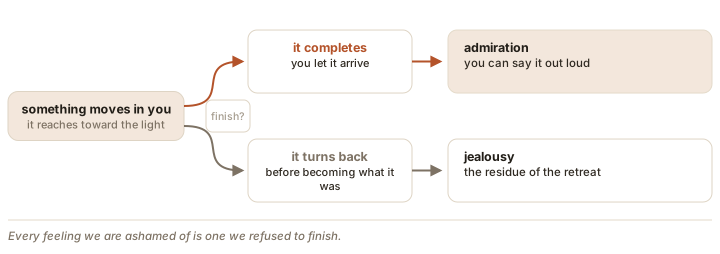
You see someone living a fragment of a life you did not know you wanted until you saw it in them. In that first instant, before judgment arrives, there is only recognition. A quiet, involuntary yes. The soul leaning forward. This is the most honest moment you will have all day, because it happens faster than your defenses can organize themselves. For half a second, you simply want.
Wanting is the root of both of the feelings that follow.
What grows from that root depends entirely on whether you are willing to remain in the open.
If you stay open, the wanting matures into admiration. Admiration is desire that has accepted itself. It does not pretend it feels nothing. It looks at the other person and allows the truth to stand: that something there is worth having, and that you do not yet have it, and that this is bearable. Admiration can survive the gap between yourself and what you long for. It can stand in that gap without collapsing. That standing is what we ought to call courage, though we rarely think to use the word for something so quiet.
Jealousy is what happens when you cannot bear to stand there.
The gap is the whole problem. To admire someone fully is to confess a lack in yourself, and lack is the one thing the proud self cannot tolerate, because it experiences any lack as a verdict. It does not hear I do not have this yet. It hears I am not enough. And so, to escape that sentence, it performs a kind of violence. It cannot close the distance to the other person, so it tries to drag the other person down into the distance instead. If they are smaller, the gap is smaller, and the lack disappears without anyone having to grow.
This is the cowardice hidden inside jealousy. Not the cowardice of fear, exactly, but the deeper cowardice of refusing to be honest about one’s own desire.
Notice how jealousy always disguises itself as judgment.
It never says I want what you have. It says you do not deserve what you have. It puts on the robes of discernment, of taste, of moral clarity, and it pronounces the other person a fraud, the success an accident, the achievement smaller than it appears. And the disguise works precisely because judgment feels superior while desire feels exposed. We would rather be the one who looks down than the one who reaches up, because looking down protects the illusion that we were never below anything to begin with.
But the disguise has a flaw, and the flaw gives it away every time.
We do not feel jealous about things we do not secretly value. No one envies a life they would never want. The very fact that a person’s existence disturbs you is proof that they are standing near something your own soul has already claimed as precious. Jealousy, then, is a kind of accidental confession. It announces our values against our will. Tell me what makes you bitter, and you have told me what you worship.
This is the strange usefulness buried in an ugly emotion.
Jealousy is unreliable as a guide to other people, but it is a near-perfect map of yourself. It points, with terrible accuracy, at exactly the things you want and do not believe you can have. The belief is the wound. Not the wanting. The wanting is healthy, ancient, the same force that has moved every person who ever built anything. It is the secret conviction that the wanting is hopeless that rots it into resentment.
And so two people can stand before the very same life and feel two opposite things, and the difference between them has nothing to do with the life they are looking at. It has only to do with what they believe about their own future. The one who believes the door is reachable feels admiration. The one who believes it is closed feels jealousy. The object is identical. The verdict on the self is everything.
Which means jealousy is, at bottom, a failure of faith. Not faith in God, or in fate, but faith in one’s own capacity to change. It is what desire becomes in a person who has quietly given up on himself and has not yet admitted it. The bitterness toward others is just the echo of a surrender he made toward his own life, long ago, in private.
To recover from it, you do not have to feel less.
You have to feel the whole thing through, instead of stopping at the bitterness. You have to follow the jealousy back to the admiration it came from, and follow the admiration back to the wanting underneath it, and then, finally, do the one thing the proud self spent all this effort avoiding. Say it. I want that. Without apology, without the asterisk, without making anyone wrong so that you can feel less alone in your hunger.
The moment you name the want, the whole structure changes.
The rival becomes a teacher. The thing that mocked you becomes evidence that the door exists, because someone is standing in its frame. The emotion that was eating you turns, almost instantly, into a direction. Nothing about the other person has to change. Only your willingness to finish the feeling you started.
So when it rises in you next, that hot and shameful flicker, do not condemn it and do not obey it. Read it. It is not a sin to be exiled. It is a signal to be deciphered. It is your own buried ambition, still alive, still pointing, using the only voice you left it after years of telling it to be quiet.
You called it judgment because that was safer.
But it was always desire, and desire only ever curdles into jealousy when we lack the nerve to own it.
Jealousy is just admiration that lost its courage.
And courage, unlike luck or talent or time, is the one thing no one can keep from you. It was yours all along. You merely have to pick it back up.