It Was Never About Whether It Mattered, It Was About Whether It Was Beautiful
It was after midnight, and there was a cockroach in the kitchen. It came out from behind the stove, unhurried, like the house belonged to it more than it belonged to me, and I killed it with a rolled-up newspaper before I had even decided to. My hand moved first. Afterward I felt nothing except the small, clean satisfaction of a job done. I was, in that moment, briefly a kind of hero. Not to anyone else. To myself.
Two nights later a butterfly got in through the same window, and I spent ten minutes coaxing it onto a piece of paper and back out into the evening, moving with the exaggerated care of a man defusing something. What I felt was a different kind of satisfaction. Gentler. More flattering. I was being good.
Here is what I couldn’t get past afterward. Nothing about the stakes had changed between the two nights. A life ended in the first case and could have ended in the second, and both lives were, by any measure I can defend, roughly equivalent: small, brief nervous systems doing what small, brief nervous systems do. If the cockroach mattered too little for its death to matter, the butterfly should have mattered just as little. If the butterfly mattered enough that saving it made me good, the cockroach should have mattered enough that killing it made me something worse than efficient. I couldn’t have it both ways. I had it both ways anyway.
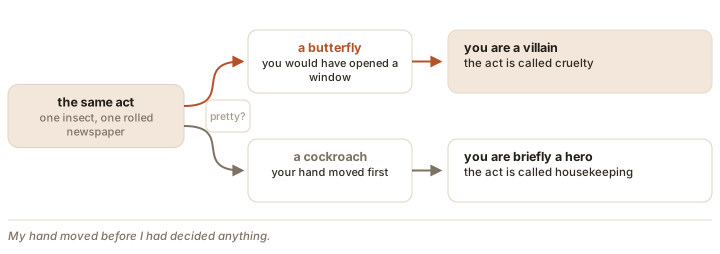
They say it doesn’t matter. They say this, specifically, about the creatures they are least willing to look at, then act, immediately and without hesitation, as though it matters enormously, just not in the direction of the insect. It matters in the direction of us. The cockroach dies and we are competent, decisive, hygienic. The butterfly dies and we are careless, or worse, cruel. The insect is not the subject of either sentence. We are. The verdict was never about the bug. It was about what killing that particular shape, in that particular light, would make us feel about the kind of person we are.
This is not a small, private oddity. It has been measured. In 1972, Karen Dion and her colleagues showed people photographs of strangers, sorted only by attractiveness, and asked them to guess at the strangers’ character. The good-looking ones were assumed, with no other evidence at all, to be kinder, warmer, more trustworthy, headed for happier marriages and better jobs. A meta-analysis nineteen years later confirmed the halo was real, then quietly narrowed it. The effect was strongest for competence and social charm, almost nonexistent for integrity, for honesty, for whether the person actually treated others well. We do not look at a beautiful face and conclude someone is good. We look at a beautiful face and conclude someone is impressive, capable, worth knowing, and let that conclusion borrow the costume of goodness, because the two feel the same in the body.
We do this with the living too, not only the dead. We read hesitation in an unpolished person as guilt, the same hesitation in a polished one as humility. We call the attractive candidate a natural leader before they have led anything, and mistake the pleasant feeling a person gives us for evidence of who they are. The content does not change. The packaging testifies, and we let it.
The same blindness, at a planetary scale, is deciding which species get to survive. An audit of nearly fifteen thousand conservation projects, close to two billion dollars spent between 1992 and 2016, found vertebrates, the animals with faces we recognize as faces, absorbed 83 percent of it, plants and invertebrates splitting roughly seven percent each, fungi and algae barely registering. Only about six percent of the world’s threatened species ever saw a dollar of targeted funding, and almost a third of the money went to species that were not even endangered. They were simply well liked. At a Paris zoo, giraffes and jaguars drew something on the order of forty times more donations than vultures or tarantulas, and endangerment made almost no difference to how much people gave. Charisma decided. Not risk. Not need. Charisma.
And in a cruel closing of the loop, the animals rated most charismatic by Western audiences, the tiger, the lion, the elephant, the panda among them, are nearly all sliding toward extinction while the public, saturated in their images on toys and logos and screens, largely believes they are fine. One popular toy giraffe sold more units in a single year than there were giraffes left alive in the wild, eight times over. We love them into a false sense of their own survival.
This is the cockroach and the butterfly again, wearing a bigger body. We do not reserve our leniency, our compassion, for what needs them. We reserve it for what moves us, then tell ourselves the moving and the meaning were the same event. We forgive our own worst mornings if we caught our reflection looking decent in them. We do it with insects, with the animals we choose to save, with the strangers we trust on sight.
The butterfly I saved that night was not more alive than the cockroach I killed two nights before. It was only better lit. I think about that sometimes, standing at the same window, in the same kitchen, at the same hour. The wings help. The wings have always helped. That was the whole trick, and none of us were ever really fooled by it. We just liked how it felt too much to say so.
It was never about whether it mattered. It was about whether it was beautiful.