Imposter Syndrome Did Not Start With AI, It Just Found a New Reason
I asked an AI to help me finish a sentence I had been circling for twenty minutes, and it gave me back almost exactly what I meant, in about four seconds. I read it twice. It was good. Better than what I would have written alone. And underneath the relief, something else showed up uninvited, a small, cold thought that said: you did not actually do that.
That thought is imposter syndrome. It just found a new disguise.
For most of the last fifty years, imposter syndrome was a story about credentials. You got the job, the degree, the promotion, and some part of you stayed convinced it was a clerical error, that any minute now someone would check the paperwork and realize you did not belong. It lived in rooms full of people who seemed more certain than you felt.
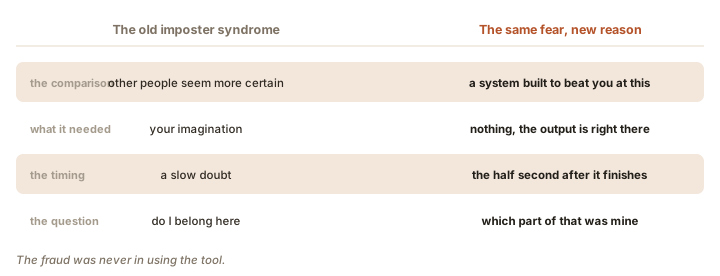
Now it lives somewhere quieter and stranger. It lives in the half second after AI finishes your sentence, your code, your pitch deck, your apology email, and the work lands, and you cannot tell anymore which part of the good result was actually yours.
This is not the same fear wearing new language. It is an old fear that finally found a partner who could keep up with it.
Before, imposter syndrome needed you to imagine that other people were better than you. Now it does not need your imagination at all. There is something outperforming you, measurably, in seconds, and it never gets tired, never has a bad morning, never needs a walk to remember why it started this work in the first place. Comparing yourself to a person was always a little unfair. Comparing yourself to a system built by thousands of engineers to specifically beat you at this one narrow task is not unfair. It is just the wrong contest to keep having with yourself.
I have caught myself doing the quiet math. If a model can draft this in four seconds and I take forty minutes, what exactly was I contributing in those remaining thirty nine minutes. Was it thinking, or was it just the slower version of the same output. I have sat with that question longer than I want to admit, because the honest answer is uncomfortable. Some of those minutes were genuinely mine, my judgment, my taste, my sense of what the sentence actually needed to mean. Some of them were just friction I had been mistaking for effort.
That distinction matters more than it sounds like it does. Because if you cannot tell the difference between effort and value, you will start using effort as proof that you are still necessary. You will slow yourself down on purpose, decline the shortcut, do it the hard way, just so the ache in your shoulders can testify that you still matter. That is not integrity. That is grief wearing the costume of discipline.
Somewhere in me, a very old rule still runs quietly in the background. If it did not cost you something, it does not count. That rule was written long before machines could write. It never had to answer for a world where the easy way and the right way could be the exact same sentence.
I do not think the fraud was ever in using the tool. I think the fraud would be pretending the tool erases the years it took you to know a good sentence from a merely fluent one, a real solution from one that only looks finished, a decision you can stand behind from one that was simply convenient. The machine can produce the shape of competence in seconds. It still cannot tell you what you actually meant, what you were actually trying to solve, what would actually be true for the person on the other end of it. That part was never about typing speed. It was never really about the output at all.
I do not think this feeling gets resolved by proving something to a machine that cannot be impressed either way. I think it fades the same way the old imposter syndrome did. Quietly. By doing the work often enough that you stop needing the discomfort of it as proof you are allowed to be here.
You are not a fraud for letting something else finish your sentence.
You would only be one if you forgot you were the reason it was worth finishing at all.