How We Stretch Time Without Stopping It
Time never bends. A minute is always a minute, an hour is always an hour. Yet it does not feel that way to us. Some days pass so quickly we barely notice them, while others linger in our minds as if they carried more weight.
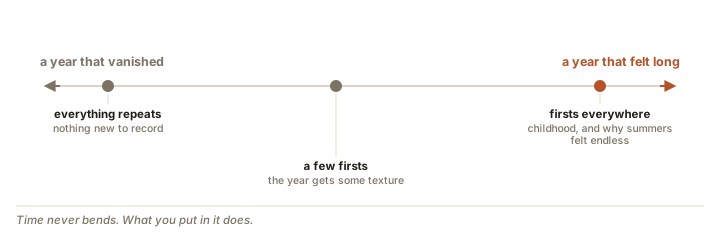
Think about childhood. Those years felt endless. Summers felt like entire lifetimes. Every school year brought something new, from learning how to read to making your first friend to riding a bike for the first time. Life was full of firsts, and firsts are sticky. They make memories dense, and dense memories make time feel stretched.
Then adulthood arrives. Weeks and months blend into one another. Wake up, work, eat, sleep, repeat. Suddenly entire years disappear, and we find ourselves asking, where did the time go?
Why time goes by so fast as you get older
People have asked this for as long as they have been getting older, and the answers that have held up point in three directions. None of them says the clock changed.
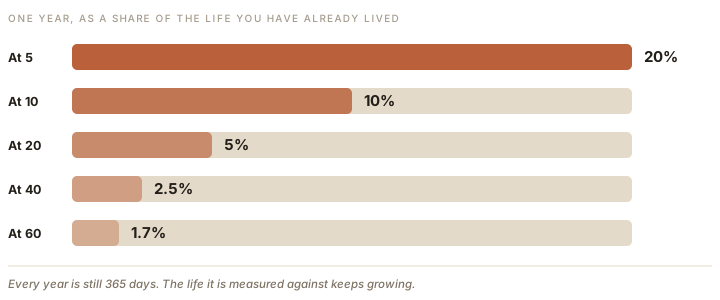
The first reason is arithmetic. In 1877 the French philosopher Paul Janet noticed that we seem to weigh each year against the whole of the life we have lived so far. To a ten year old, a year is a tenth of everything they have ever known. To a fifty year old, it is a fiftieth. The year did not shrink. The life around it grew.
The second reason is memory, and it is the only one of the three you can do anything about. When life becomes routine, our brain stops recording details. Days become copies of one another. And when memory fades, so does the sense of time. We judge how long a stretch of the past was by how much of it we can recall, and a year of identical Tuesdays leaves almost nothing to recall.
The psychologist Claudia Hammond calls one version of this the holiday paradox. A good holiday flies while you are inside it, then feels long when you look back, because a week of new streets and new faces lays down more memories than a month at your desk. A dull afternoon does the opposite. It drags while you live it and leaves nothing behind.
William James saw the same thing in 1890. He took up Janet’s idea in The Principles of Psychology and decided the arithmetic could not be the whole story. The foreshortening of the years as we grow older, he wrote, comes in great part from “the monotony of memory’s content.” Life seems longer in childhood because it is full of novelty, and shorter in adulthood because it is not. He was right, though right is doing a lot of work there. None of these three has been tested the way a finding is tested, which is the more skeptical case I make on the grid itself. Novelty is the substance that makes memories form, and memories are what give us the feeling that life was lived fully.
The third reason is physical, and newer. In 2019 Adrian Bejan, an engineer at Duke University, argued in the journal European Review that the mind experiences time as a sequence of images, and that we take in fewer of them as we age, because the nerve pathways that carry them grow longer and more tangled and then begin to wear. A child’s day holds more frames than an adult’s. Played back, the adult’s day is shorter.
So it is not that time moves faster as we grow older. It is that we stop giving time reasons to stand out.
How to slow time down
You cannot stop getting older, and every new year will keep being a smaller slice of the whole. The arithmetic and the biology are not yours to change. The memory is.
To stretch time, we need to disrupt monotony. Not recklessly, but deliberately. A new trip, a new skill, a new friendship, a new challenge. These things are not just experiences; they are bookmarks in the story of life. They make one year look different from another when we look back.
The irony is that routine is necessary. Without it, we cannot progress, build, or grow. Routines help us achieve, but they also blur time. So the challenge is balance. Enough repetition to create stability, but enough novelty to create meaning.
Think of your life as a gallery. Routine paints in shades of gray. Novelty adds the bright colors. Without gray, the colors might feel overwhelming. Without colors, the gallery looks dull.
The art of a well-remembered life is in mixing the two.
If you want to stretch time, you do not need to chase extreme adventures. Sometimes even small changes are enough. Taking a different route to work. Cooking a meal you have never tried before. Talking to someone outside your usual circle. Writing your thoughts instead of scrolling endlessly.
Attention matters as much as novelty. An hour spent half there, thumb moving, eyes elsewhere, is an hour the mind barely bothers to store. And one line written at the end of each day, even a dull day, turns weeks that would have blurred together into days you can find again.
Every small change gives your brain something new to hold on to. And when you look back, those small details will be the ones that slow time down.
Because time itself never slows. Only our experience of it does.