You Do Not Think for Yourself by Collecting More Voices
You type the question before you have finished having the thought.
Not on purpose. The thought was there, half assembled, one of those shapes with a feeling attached but no sentence yet, and your hands were already moving, because the keyboard is where unfinished things go now. You describe the problem to the model to find out what you think about it. Four seconds later there is a paragraph on the screen, cleaner than anything you had, and whatever you were about to think is gone. You will not notice it is gone. The thought was not argued down. It was overwritten before it finished forming.
The worry everyone voices is that the machine will do our work. The nearer problem is that it answers before we have finished asking, and the only cost is a pause nobody was measuring.
Two things about that pause.
In 2002, Leonid Rozenblit and Frank Keil asked people how well they understood ordinary objects. A zipper. A cylinder lock. A sewing machine. Most rated themselves fairly high, and why not, you have used a zipper your whole life. Then they were asked to write out how the thing actually works, and rate themselves again. The second number dropped hard. They called it the illusion of explanatory depth, and the detail that matters is where it shows up. It is specific to things with working parts, and it barely appears for procedures or for plain facts. What you have, before you try to produce it, is the feeling of an explanation. The opening sentence of one.
Thirteen years later, Fisher, Goddu and Keil ran nine experiments on what searching does to that feeling. Looking an explanation up on the internet raised how much knowledge people believed was inside their own heads, not merely how much they could reach. Those studies did not measure whether the answers got better, and I will not pretend otherwise. The line between what you know and what you can fetch is not a line your confidence respects.
Search at least made you type a query and choose between links. A model hands over the finished thought in your own register, as though you had been the one to have it.
Which brings me to something I wrote and want to argue with.
I have claimed that the reason your opinions change after every book or podcast is that you have not read enough yet, and that the repair is to read more, listen more, let the ideas collide. That essay is right about what it was looking at. A mind with one voice in it belongs to that voice. But collide is carrying the whole sentence, and ideas do not collide on their own. They sit next to each other and wait. The one with better prose wins, and what you experience as resolution is usually the most fluent voice in the room getting the last word. What I would take back is the arithmetic underneath, which says enough voices eventually add up to a position of your own.
They do not. A bigger jury is still a jury.
Reading more is how you acquire better opinions. It is not how you produce one. A question arrives, you consult the voices, you adopt the strongest answer available. Nietzsche instead of a podcast host is a better grade of borrowing and still borrowing. If more perspectives were the cure, the model would be the cure, because it holds more voices than any shelf and will give you any side of any argument in a tone of complete calm. The largest jury ever assembled has made nobody more original. It has made everybody faster.
Thinking for yourself cannot mean independence from influence. That was never on offer. Everything in your head arrived from somewhere, including this.
The move that is actually yours is smaller and harder than reading widely. You commit to a conclusion before you check whether anyone agrees.
Say what you think the answer is, on paper, badly, with nothing supporting it. One sentence, written down, with a date next to it. Then go and look. Zhi, Kumar and Lee reported at CHI this year that people who worked part of a problem out themselves before consulting a chatbot did better on a critical thinking task than people who went to it first. Under time pressure, early use helped, so the trade between speed and independence is real. Most of us have been choosing speed and calling it efficiency.
Why the order matters shows up in a preprint from Shaw and Nave: three preregistered experiments, 1,372 people, 9,593 trials. They separate offloading, which is handing over a task while you keep reasoning, from what they call cognitive surrender, taking the output with almost no scrutiny. When the model was right, accuracy rose roughly 25 points above baseline. When it was wrong, accuracy fell about 15 points below the score of people working with no model at all. Not below the lucky ones. Below the people working alone.
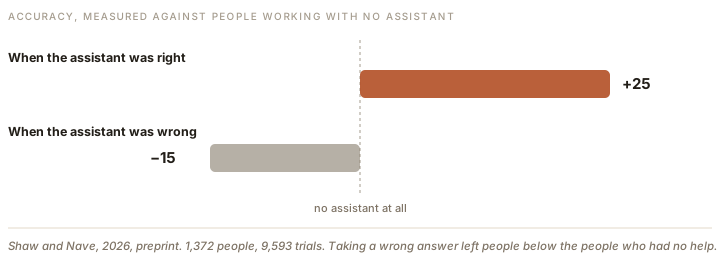
Your own prior answer is the only instrument for telling a good output from a merely plausible one. Without it you are not evaluating. You are receiving.
You keep more of what you make, too. Slamecka and Graf showed in 1978 that material you generate yourself is remembered better than the same material handed to you. Even a wrong first attempt leaves a hook that a correct paragraph you merely read never will.
Then the half that takes longer. Having committed, you let your own life decide whether it holds. Not the next book, and not the next model. Agreement cannot be corrected. It can only be replaced, which is what has been happening to you after every book. A thought becomes yours around the time you act on it and pay for it. Before that it is a rental, however many sources you consulted before signing. Your own life is slow, bad at explaining itself, and the only grader with anything at stake.
None of this argues for doing things the hard way on principle. I have written about the cold thought that arrives when the machine finishes your sentence better than you would have, and about the temptation to add friction back in so the ache can testify you are still necessary. That is not independence either. The model’s speed is not the problem. The missing five seconds before you reach for it is.
Most of what you type into a box never needs to be yours. I have argued that you do not need an opinion about everything, and the relief in that still stands. Save the commitment for the questions where being wrong would cost you something. Those are the only places a position of your own does any work.
So the next time your hands move before the thought lands, stop for one breath and write down the worst version of your own answer. It will be clumsy and often wrong. It will also be the only thing on the screen carrying your weight, and the answer that arrives next will have something to land against.
The jury does not go away. It can be large, well read, genuinely wise. It can sit for thirty years taking evidence. It will still never have been you.