You Will Not Stop Caring What People Think. You Can Only Choose Which People.
You rewrite the message four times before sending it.
Not because the meaning changes. It does not. You move a word, delete the exclamation mark, put it back, read the whole thing again in the voice of the person who will receive it, and only then press send. The message took nine seconds to think of and four minutes to approve. Somewhere in those four minutes a committee met, and you were not the chair.
Everyone has the same advice for this. Stop caring what people think.
It is the most repeated sentence in the entire business of self improvement, and almost nobody who says it can tell you how. That is because it cannot be done. You are not built for it. For most of the time humans have existed, being disliked by the group was not embarrassing, it was dangerous, because the group was the only source of food and warmth and protection there was. Being cast out was a sentence. What you feel when you imagine someone thinking badly of you is not vanity. It is equipment, doing exactly what it was shaped to do, on a threat that has mostly stopped existing.
Telling that system to switch off is like telling yourself to stop flinching at a loud noise. You can practise. You will still flinch.
So the useful question is not how to care less. It is who you have agreed to care about, and whether you ever agreed at all.
Before that, two facts that shrink the problem.
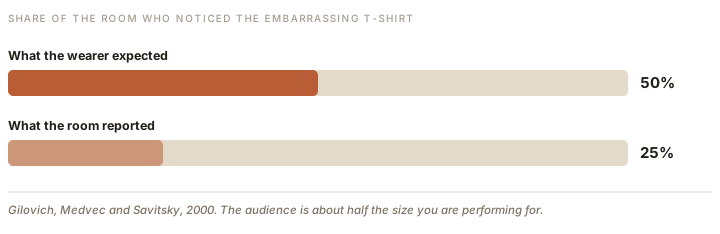
The first is that the audience is smaller than you think. In 2000, three psychologists at Cornell, Thomas Gilovich, Victoria Medvec and Kenneth Savitsky, asked students to put on a T-shirt they found embarrassing and walk into a room of other students. The wearers guessed that about half the room had noticed. About a quarter had. They called it the spotlight effect, and they found it again with flattering shirts, which is the part people forget. The crowd is not withholding approval. The crowd is thinking about itself.
The second is that the people who are looking tend to like you more than you assume. In 2018, Erica Boothby and her colleagues put strangers in conversation and then asked each of them two questions: how much did you like them, and how much do you think they liked you. The second number was reliably lower than the truth. They called it the liking gap, and it held for strangers in a lab, first year students meeting their dorm mates, and adults at a workshop. People walk out of conversations convinced they did worse than they did.
Put those together and the jury you are afraid of is half the size you imagine and friendlier than you assume.
It still exists, though. That is the honest part. Some people are watching, some of them are judging, and a few of those are right.
Which is why the move is not to stop caring. It is to stop caring at random.
Because that is the actual problem. Not that you care, but that you never chose. The committee in your head filled itself, the way a room fills when a door is left open. A colleague you do not respect. A relative who has been wrong about every major decision in her own life. Someone from school you have not spoken to in eleven years, who exists now only as a face that would smirk. None of these people applied. None of them were interviewed. They are simply in the room, and their imagined opinion has been given the same weight as the opinion of people who have actually shown up for you.
The people who have actually shown up are a different problem, and a slower one. With them the fear does not make you rewrite a message, it makes you agreeable in a hundred small ways until you cannot find yourself in the record of your own life. That is the subject of how you lose yourself trying to keep people. This essay is about the rest of them, the ones whose opinion you never agreed to carry.
So make the list. Three names, five at most. The test for the list is not how much you love someone. It is whether their disappointment would teach you anything. Who has seen the worst version of you and stayed in the room. Who would tell you the truth in a way that costs them something. Whose own life is arranged in a way you would be willing to trade for. That is your jury. Everything outside it is weather. You dress for weather. You do not argue with it.
Then, when the flinch comes, and it will come, you get one question instead of four minutes. Is this person on the list.
Almost always they are not, and the decision stays yours.
When they are, there is a second question worth asking, because the list can be wrong too. Would I still do this if no one on the list would ever find out? If the answer is yes, you are doing it for yourself and their opinion is a bonus. If the answer is no, you have not found your standard. You have found a nicer landlord.
None of this is clean, and the essays that promise otherwise are lying. There are days when the list is sitting right there and a stranger’s expression still rearranges your afternoon. Choosing a jury does not free you from a jury. It only means the weight lands on people whose weight you have agreed to carry, which is different from being crushed by everybody at once.
And there is a failure at the other end, which nobody warns you about. A jury of one, yourself and no one else, is not independence. It is a locked door with a better name on it. I have written before about solitude that is really postponement, and the same trick runs here. The goal was never to become unreachable. It was to be reachable by the right people.
The message still takes four minutes some nights. But now the committee has names, and most of them are not in the room.