When Will You Be Forgotten?
You die twice. Once when you stop breathing, and again on the day your name is spoken for the last time. This works out roughly when the second one happens, and what actually moves it.
Free, and nothing you enter leaves your browser.
Your name is likely spoken for the last time in
What each path actually does
Most ways of being remembered do not make your name spoken. They make it stored. Those are different things, and only one of them is what this page counts.
Stored is not spoken
The idea is older than the quote everyone attributes to Banksy.
The neuroscientist David Eagleman set it out in Sum: there are three deaths. The first is when the body stops. The second is when the body is buried. The third is that moment, sometime in the future, when your name is spoken for the last time. The Stoics had a phrase for the same shape of thought, mors trium temporum, death in three times. You will also see the line credited to Banksy, Hemingway, Goethe and Laurie Anderson. Quote Investigator went looking for a source for each of those and could not find one that holds.
Families forget in three generations, not three centuries.
This is what turns the third death from a poetic idea into a date you can put on a calendar. In a 2022 survey run by OnePoll for Ancestry, covering just over two thousand American adults, more than half could not name all four of their grandparents. Only four percent could name all eight great-grandparents. An earlier Ancestry survey found twenty one percent could not name a single one. It is worth being clear that this is a marketing survey commissioned by a genealogy company rather than peer reviewed research, so treat the exact percentages loosely. The shape of it is not in doubt, and the shape is the point. Three ordinary lifetimes is the whole distance.
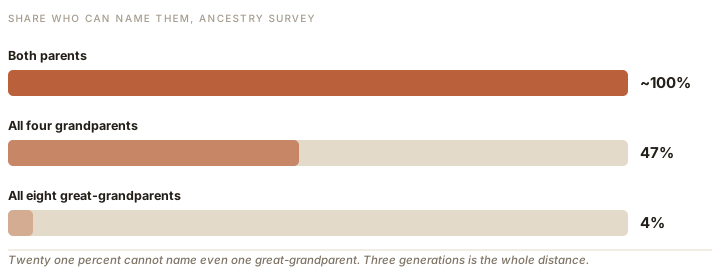
Almost everything people do for posterity produces storage, not speech.
A book you write is catalogued and kept, possibly for centuries. That makes your name findable. It does not make anyone say it. The same is true of a patent, a headstone, a company registration and a photograph with your face in it. All of these are records. A record sits still and waits to be looked up, and mostly nothing looks it up.
There is one exception, and it is the interesting one. A thing named after you that recurs. A scholarship awarded every year, a prize, a lecture series, a ward in a hospital. Somebody has to read the name aloud each time it happens. The Nobel Prize has been awarded since 1901 and Alfred Nobel's name is said out loud, in public, every single year. The Rhodes Scholarship has done the same since 1902. That is the only mechanism I can find that reliably keeps a name in speech rather than in storage, and it is available at far smaller scale than a Nobel. A recurring award at a school costs very little.
Fame is a bigger number, not a different kind of number.
Researchers have tracked famous names through the Google Books corpus and found that fame behaves like a half life. It rises sharply and then decays over decades. The modern version is worse, not better: fame now arrives faster and higher, and falls away more steeply than it used to. Genuinely famous people stay known for decades, which is longer than the rest of us get, and still nothing like forever. If your plan for the third death is to become well known, the plan buys you time rather than an exit.
What the number is actually for.
It is not an argument that nothing matters. It is a narrowing of the question. If your name lasts roughly a century and a half from your birth, then almost everything you do is for people you will actually meet, and not for posterity. That is a much smaller stage than most ambition assumes. It is also a far more reachable one, and the people on it can hear you.
How this is calculated, and where the numbers come from
There is no dataset of when names stop being spoken, so the dates are a model. It works out your birth year from your age, assumes each generation arrives at the age you entered, and assumes everyone reaches the life expectancy you entered. The last person who could plausibly have met you is your youngest grandchild, so your third death is placed at their death, with a short tail for the great-grandchildren who are told your name and hold on to it. If you teach, the model also tracks the youngest person you are likely to teach and how long they live, and reports whichever of the two runs later.
The country presets are real figures rather than guesses. India uses a life expectancy of about seventy two and a first birth around twenty one, from national survey data. The United States uses seventy nine, the record high reported by the CDC for 2024, with a first birth at 26.4. The United Kingdom uses 81.7 and 28.7. Change any of them and the date moves, which is the honest part. A twenty five year generation gap with a seventy five year life gives a very different answer to thirty five and ninety, and both describe real lives. The point was never the precision. It is the order of magnitude, and the order of magnitude is far sooner than most people guess.
Questions
What is the third death?
The first death is when your body stops. The second is when your body is buried or burned. The third is the last time anyone says your name out loud. The framing comes from David Eagleman's book Sum, and the Stoics described the same three stages centuries earlier.
Is this based on real data?
The forgetting curve is: a 2022 OnePoll survey for Ancestry of just over two thousand American adults found 53 percent could not name all four grandparents and only 4 percent could name all eight great-grandparents. Life expectancy and age at first birth come from national statistics. The dates themselves are a model built on those inputs, described in full above.
Does being famous change the answer?
Less than people expect. Research tracking famous names through the Google Books corpus shows fame decays like a half life, and modern fame decays faster than it used to. Fame buys decades. It does not buy an exit.
What actually keeps a name spoken?
A recurring thing named after you. A prize, a scholarship, an annual lecture. Someone has to read the name aloud each time. Alfred Nobel's name has been said in public every year since 1901. A book, by contrast, keeps your name findable rather than spoken.
What if I do not have children?
Uncheck children. The chain then ends with the people who know you personally, which usually brings the date closer. That is not a judgement, and if you teach or mentor, tick that instead, because it is often the longer path.
Does anything I enter get sent anywhere?
No. The whole thing runs in your browser. There is no account, no upload and no storage.
The longer version of this thought is in the quiet power of being remembered, the geometry of impact and you do not fear death, you fear an unlived life. There is also life in weeks, which counts the other end of the same problem.