Choosing to Be Alone Is Not Peace, It Is Postponement
The kettle clicks off at nine. No one else hears it.
I stand in the kitchen of an apartment I chose for exactly one person, and notice, the way you notice weather, that I am not lonely. The dishes from dinner are still in the sink, one plate, one fork, one glass with a half inch of water going warm. Outside, the street empties itself of the last footsteps. Inside, there is only the sound my own body makes when it moves.
For a long time I called this peace.
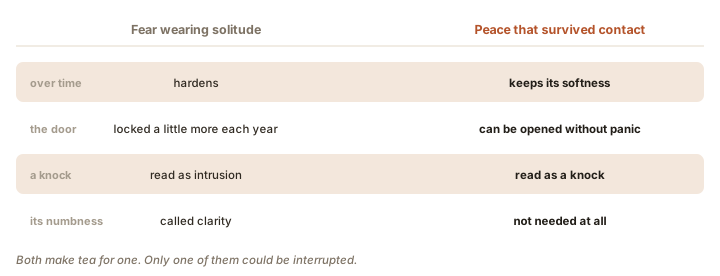
I still might. But there is a version of solitude that is the fruit of a life fully lived, and a version that is scar tissue grown over a life that once got hurt trying. From across the room they look the same. Both sit quietly. Both make tea for one. Both fill the extra hour with something they call progress. Both say, when asked, that they are fine, actually, better than fine, that they have never felt more like themselves.
Only one of them is telling the truth.
There is a difference between a room that is quiet because it is at rest and a room that is quiet because someone left it and shut the door. You cannot hear the difference from the hallway.
There was a year I told people I was choosing myself when what I was actually doing was hiding in a form respectable enough to survive small talk, a calendar so full of goals that no one thought to ask what I was running from, only what I was running toward. No one questions a person who says they are working on themselves. Everyone questions a person who says they are afraid.
That is the quiet trick of it. Withdrawal, dressed correctly, reads as strength. Fear, if it learns the right vocabulary, can pass for peace at every checkpoint, and these days it has learned a second vocabulary just as convincing, the vocabulary of getting things done. Fear needs a philosophy. It needs a name for itself so it does not have to admit what it is, and a full calendar works as well as any doctrine. No one asks a person who is always working what they are working so hard to avoid. You can build an entire identity around never being chosen wrong again by simply never being chosen at all, and call the architecture independence, or call it ambition, and either word will do, because both keep the door shut for reasons that sound like virtue.
I am not saying solitude is a wound. I am saying a wound can wear solitude like clothing.
If you are asking why you like being alone so much, start by giving the good reasons their due, because most of them are good.
Company, even company you love, is a kind of work. You read faces, adjust your tone, stay legible to someone else. Being alone is the only hour in the day when no one is reading you, and the relief of that is not a symptom of anything. It is rest.
Psychologists have measured it. In a set of studies published in 2018, Thuy-vy Nguyen, Richard Ryan and Edward Deci found that time alone reliably turns down strong feelings, the anxious ones and the excited ones alike. When people had chosen to be alone, the quiet came out as relaxation and less stress, not exile. And it is not only introverts who feel it. A 2022 study in PLOS One found that people who seek solitude for its own sake are marked less by introversion than by autonomy, a sense that their lives are their own.
What decides whether solitude helps or hurts is not how much of it you have. It is why you went looking for it. In 2019 Virginia Thomas and Margarita Azmitia separated the two. Solitude sought for its own sake, for rest or reflection or the plain pleasure of it, went along with well being. Solitude sought to get away from people went along with loneliness, social anxiety and depression. The room is the same in both cases. The reason is not.
Which is this whole essay, in two lines of a questionnaire.
The only honest test I have found is time, and what a person does inside it. Peace, the real kind, keeps its softness. It has already survived contact, which is what makes it peace and not theory. It can watch someone else fall in love without flinching, can sit across from a stranger and feel warmth instead of calculation, can be interrupted without becoming furious at the interruption. Fear, no matter how well it is dressed, hardens. It needs the door locked a little more each year. It mistakes every knock for an intrusion. It calls its own numbness clarity.
Diogenes lived apart from every convention of his city, and none of it was hiding. When Alexander found him and offered him anything he wanted, Diogenes did not flinch or scramble to explain himself. He asked the most powerful man alive to step out of his light. That is what real distance looks like when it is finally tested. It can afford to be interrupted, because it was never hiding from the interruption, only from the noise. My solitude, most days, is not that. Most days I fill the hours on purpose, task after task, so that if someone did knock, I would already have a reasonable excuse waiting by the door.
I still do not always know, some nights, which one I am standing in.
So I have stopped asking myself if I am at peace. That question answers itself too easily, too fast, already rehearsed. I ask a harder one instead. Would I let someone in, if the right person knocked. Not out of loneliness. Not to prove anything. Just because I wanted to.
Some nights the answer is still no. Quietly, reliably no. On those nights I know exactly what I am living in, and it is not peace.
But I have started asking the question, which is already a kind of movement. Not toward anyone in particular. Toward honesty about why the room stays quiet.
The kettle clicks off at nine again, another night, months later. Same apartment. Same one plate. But this time I sit at the table instead of eating standing at the counter like a man in transit through his own life. I let the silence stay a while before I turn on the radio. I am not performing peace for anyone tonight, not even myself. There is no task open on the table, nothing I am optimizing, nothing left to build before I am allowed to rest. Just the radio, low, and the room letting itself be exactly as empty, or as full, as it actually is.
Maybe that is the only difference that matters in the end, not whether you are alone, but whether you can still be found.
Choosing to be alone is not peace. It is postponement, until you finally decide what you were postponing it from.